







Rifleman Q&A: Flaming Bayonet
Q. I was recently reading a book on World War I and came across a brief reference stating that the U.S. Army had a “flaming bayonet” during the war, which is something I had never heard of. Was there such a thing?
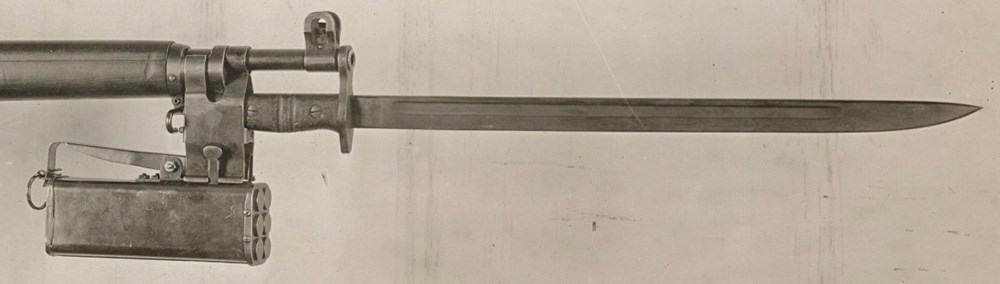
A. Indeed, there was. During the First World War, the Army looked at a number of unique options that might be useful to our troops fighting in France. One of the ideas proposed was a “flaming bayonet” that was essentially a small flamethrower attached to a rifle. The first pattern utilized liquid fuel and was found to be unsatisfactory, so a type that used pyrotechnic canisters was fabricated.
- Buy All-American!
- Bring health and vitality back to your body with these non-transdermal patches
- Get your Vitamin B17 & Get 10% Off With Promo Code TIM
- How To Protect Yourself From 5G, EMF & RF Radiation - Use promo code TIM to save $$$
- The Very Best All-American Made Supplements On The Market
- Grab This Bucket Of Heirloom Seeds & Save with Promo Code TIM
- Here’s A Way You Can Stockpile Food For The Future
- Stockpile Your Ammo & Save $15 On Your First Order
- Preparing Also Means Detoxifying – Here’s One Simple Way To Detoxify
- The Very Best Chlorine Dioxide
- All-American, US Prime, High Choice Grass-Fed Beef with NO mRNA, hormones or antibiotics... ever!
As stated in History Of Trench Warfare Material, Army Ordnance 1917-1919:
“Flaming bayonet, cartridge type, Mark I. Weight 5/8 pound. To be attached to the muzzle of the rifle in convenient position for operation when the rifle is held in position for bayonet fighting. Intended for the projection of a burst of flame from 5 to 15 feet long.”
The handful of photographs that exist depict it being used with the Model 1917 rifle, but it could have been adapted to the Model 1903 rifle as well.
Several variations of the device were tested, but, perhaps not surprisingly, it proved to be unreliable, cumbersome and likely to be of dubious usefulness in actual combat. As a result, it was never issued. Only a few prototypes were made, and by early 1919, the concept was dropped, never to be resurrected.
—Bruce N. Canfield, Field Editor
Article by BRUCE N. CANFIELD, FIELD EDITOR